
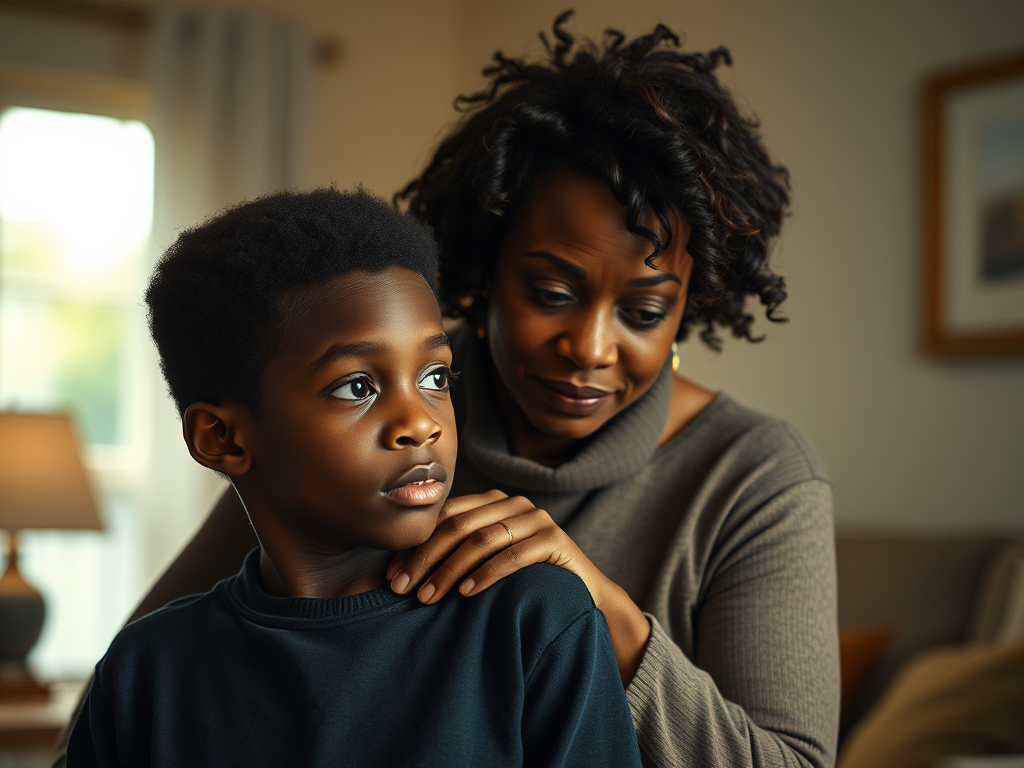
Let me tell you something about being a parent, a former teacher, and a Black mama who knows better: it’s a wild ride when your own child starts acting up in the very ways you used to shut down in your classroom. My 10-year-old son—brilliant, hilarious, and full of potential—is currently testing every nerve I’ve got. Not with big, scary things. No, no. With the slow-drip kind of chaos: making noises in class, talking when he shouldn’t, walking away when redirected. His grades? Whew. Let’s just say they’ve taken a nosedive.
Now, I’m not new to this. I used to run a classroom like a tight ship. I had systems on systems—privileges, consequences, proactive strategies. I didn’t need to call home because I was the intervention. So when my son’s teachers started calling me like I was the only adult in the building, I did what I’ve always done: I showed up. I answered every text. I reinforced every consequence. I built a behavior plan that would make my former principal weep with pride.
But here’s the thing: I’m starting to feel like I’m the only one holding the line. And I say this with love and hesitation because I know teachers are drowning. Human beings, even those that teach, have real limits to what they can emotionally withstand. I know what it looks like when adults trigger and escalate situations.
My wife’s cousin—also a powerhouse mama, also raising a Black boy—just started working at her son’s school in another state. She does not know if she wants to return. She’s feeling it too. That same exhaustion. She witnesses the disrespectful tone adults take with students. How this triggers reactions in the students. And then those same adults blame the student for disrupting the learning environment. It’s done more often than we talk about. But the only headlines we see are those in which Black kids are violent and Black mothers are inadequate.
The System Is Not Okay
Let’s talk numbers. Black boys are suspended at nearly twice the rate of white boys for the same behaviors (U.S. Department of Education). They make up 15% of public school enrollment but 38% of suspensions (Brookings). And when they do get a Black male teacher? Their outcomes improve significantly (Harvard Gazette). But guess what? Only 2% of teachers are Black men.
So yeah, the system is not okay. And we’re parenting in the middle of it.
Meanwhile, in the Algorithm…
Let’s not forget the Red Pill rabbit holes waiting for our boys online. These communities preach that women are the enemy, empathy is weakness, and dominance is destiny. According to the Journal of Gender Studies, Red Pill ideology uses pseudoscience and evolutionary psychology to justify male supremacy. It’s giving “fragile masculinity with a Wi-Fi signal.”
And then there’s Adolescence, the Netflix series that creeped everyone out this year. A 13-year-old boy, a murder, and a whole lot of adult failure. Variety called it “a gutting account of murder, misogyny, and teen fragility.” It hit too close to home because it is home for too many of us.
The Economy Ain’t Parenting With Us Either
Let’s be real: parenting is hard enough without the economy playing dodgeball with our budgets. The U.S. debt is ballooning past 100% of GDP (Bipartisan Policy Center), inflation is still doing the most, and the labor market is giving “maybe next quarter.” We’re trying to raise emotionally intelligent, socially aware, spiritually grounded boys while also figuring out how to pay for groceries that now cost more than a car note.
And Then There’s the Savior Complex
Let’s talk about the White Savior Complex. You know the one—where well-meaning folks swoop in to “fix” things without ever asking what we need. As Healthline puts it, it’s when people assume they know best for BIPOC communities. It shows up in classrooms too, when teachers lean on Black parents to do all the heavy lifting, then call it “partnership.”
My son senses something at school that he cannot yet articulate. His frustrations surface in passing comments about the number of white female teachers in his grade. While I don’t condone those remarks, I understand the feelings behind them. Without judgment, I help him find healthier, more respectful ways to express emotions he doesn’t yet have words for. Ten-year-olds—boys or girls—should not be burdened with social theory in school, but this is America. Together, we’ve been looking at photographs of Ruby Bridges, often shown in black and white as if to distance us from the roots of contemporary white rage. Yet Ruby Bridges is only in her seventies, and those images were originally in color. Bias, prejudice, and cultural assumptions remain deeply embedded in our schools.
For further reading, check out:
- Decolonizing Aid by Vanessa Machado de Oliveira
- The White Savior Film by Matthew Hughey
- Or browse the White Savior Complex shelf on Goodreads
So here I am, asking the question out loud:
Where is the line?
Between firm and loving. Between support and overfunctioning. Between raising better boys and surviving the systems that fail them.
There’s no answer. But maybe the asking is the beginning.
Leave a Reply