
Care Economy vs. Deficit of Care
“I couldn’t watch the whole segment, I had to keep coming back to it. It was triggering.” —Chez Smith
“It was the worst-case scenario playing out not once but twice in full resolution.” —Blair Imani
“Providers and institutions are not being intentional on caring for people in their community.” —Karie Stewart
– Reflections shared on PBS News hour 11/19/2025
These reflections on the recent viral incidents featuring Kiara Jones and Mercedes Wells are not just reactions—they are indictments. They speak to a legacy of harm that stretches back centuries. I had a completely different blog cued up to publish today. But my social media feeds informed me of a far more important topic to address this moment.
So even though it is long after I would normally post my MetaCocoMom rating of some activity or event, I want to talk about the state of being a Black mom in America right now. It is directly tied to my archival research and community-based research. America, gird your loins…
As I develop my narrative literature review, the stories of Kiara Jones and Mercedes Wells serve as primary evidence of a foundational tension in Black women’s history: the extraction of Care Economy Labor versus a systemic Deficit of Care.
The Care Economy Labor: A Legacy of Extraction
Historically, Black women have been engines of the American care economy, forced to serve as both producers and reproducers. On the plantation, this labor was explicit: enslaved women birthed children who would become property and nurtured white families as wet nurses and domestic servants, all while being denied the right to mother their own kin.
Daina Ramey Berry and Kali Nicole Gross explore this dynamic in depth in A Black Women’s History of the United States (Chapter 4). They illustrate how Black women’s bodies were treated as public infrastructure—essential for the economic and social comfort of others, but stripped of personal autonomy. This is the Care Economy Labor: the expectation that Black women will carry the burden of care for society, often at the expense of their own survival.
This extraction did not stop at the edge of the cotton field; it extended into the medical examination room. The modern field of gynecology was literally birthed through the torture of enslaved Black women. Dr. J. Marion Sims, often heralded as the “father of gynecology,” built his career on this labor. He performed inhumane experiments on enslaved women—most notably Anarcha, Betsey, and Lucy—without anesthesia and without their consent. Their endurance of pain was exploited to advance medical science for others, cementing the dangerous myth that Black women do not require care, they only provide it.
The Deficit of Care: Modern Echoes
If history established the demand for Black women’s labor, the present reveals the Deficit of Care that remains their payment.
The stories of Jones and Wells reveal how this deficit manifests today. Mercedes Wells was discharged from an Indiana hospital while in active labor, only to give birth in her car just eight minutes later. Kiara Jones was left to give birth in a Dallas hospital lobby, screaming for help that came too late.
These are not anomalies; they are the direct result of a system designed to extract resilience rather than offer support. When Black women step out of the role of “laborer” and into the role of “patient”—seeking tenderness, pain management, and safety—they are often met with indifference. The “Deficit of Care” is the void left where medical ethics should be. It is the silence that follows a Black woman’s plea for help.
Why This Framework Matters
This narrative literature review uses Critical Race Theory (CRT) to analyze this specific transaction. CRT reveals that the “standard procedures” of healthcare are not neutral; they are calibrated to this history.
- Care Economy Labor tells us why Black women are viewed as strong, capable of enduring pain, and perpetually available for others.
- Deficit of Care explains why their own pain is minimized and their emergencies are treated as inconveniences.
Midwife and activist Karie Stewart’s words cut to the heart of this deficit: “Providers and institutions are not being intentional on caring for people in their community.” That lack of intentionality is the deficit in action.
Toward Justice: Balancing the Ledger
To honor Black motherhood is to disrupt this uneven exchange. It requires us to dismantle the expectation of endless labor and fill the deficit with radical, intentional support. As the stories of Jones and Wells demand, Black women deserve more than to be the backbone of the economy—they deserve justice, dignity, and joy.
Call to Action: Change the Narrative
The purpose of the Labor Pains Project is to bring the untold stories forward and to give Black women an opportunity to choose how they want to be seen.
I am hosting two intimate virtual listening sessions for Black women to explore our “multifaceted labor”—the emotional, physical, and spiritual work we do to survive.
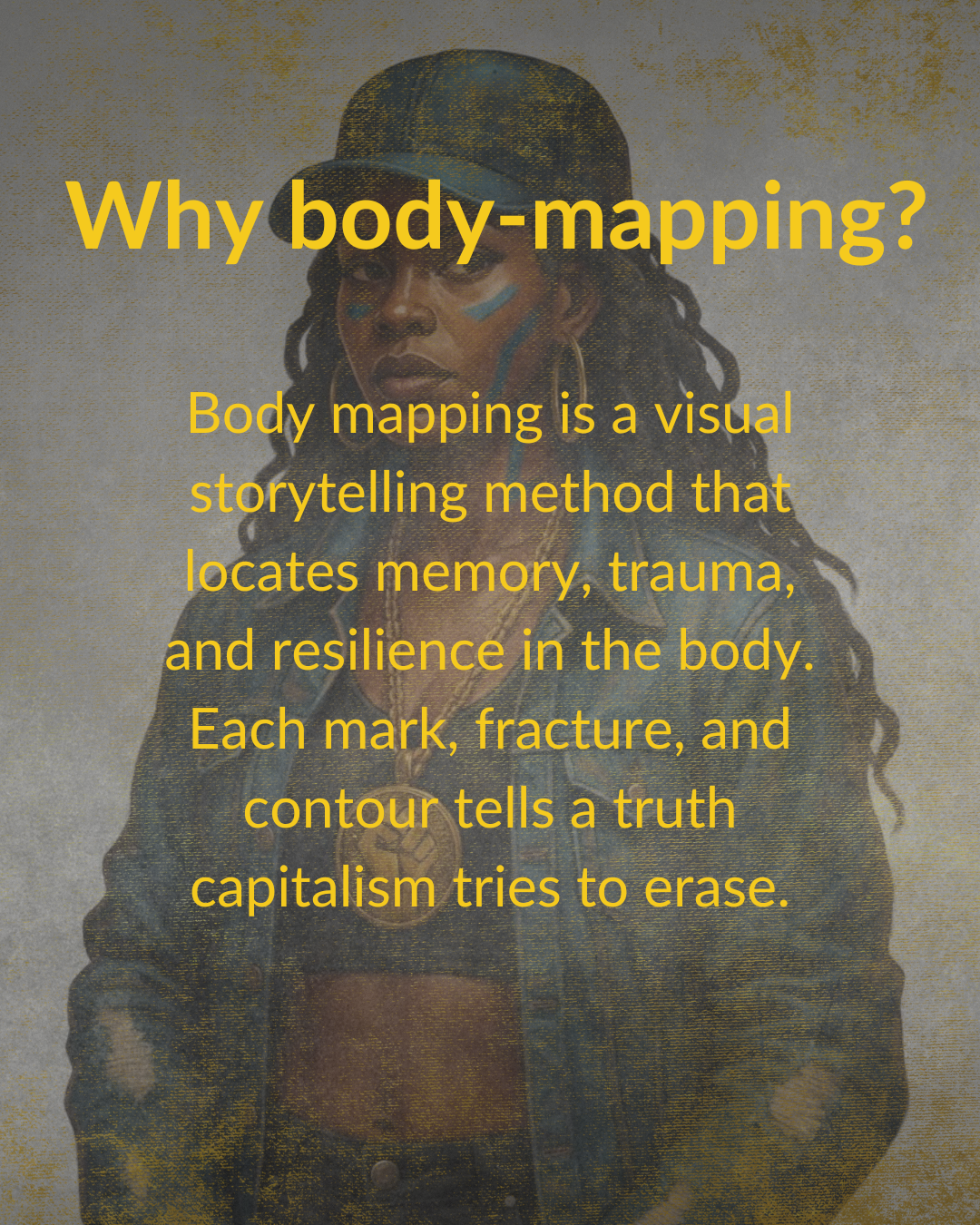
I am looking for 7 women to join me virtually (Google Meet). We will Speak (share a 2-min story), See (watch me live-map the story), and Shift (reimagine a body-map together).
📍 Calling specifically on my Albany, NY and Oakland, CA sisters.
🗓 Session 1: THIS Saturday, Nov 22 @ 12pm PST / 3pm EST
🗓 Session 2: Saturday, Nov 29 @ 1pm PST / 4pm EST

Leave a Reply