
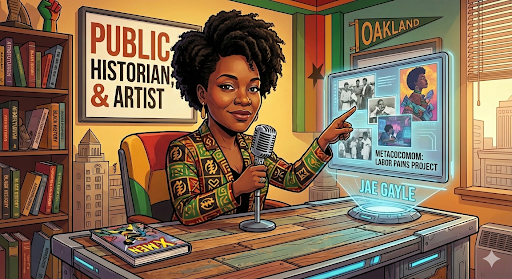
Joy and Resistance: Black Women’s Narratives in Labor
It’s really hard to hope right now. That doesn’t feel cheesy to say; it is really how I feel. My favorite movement in Gustav Holst’s Planets is Jupiter, the Bringer of Jollity. This is how I like to view myself and my energy. While I may be tightly wound when it comes to how I expect things to go, I do love a bit of joy along the way. I am an Enneagram 7: The Enthusiast. I LOVE joy, in almost any form. Which is also why I have a problem with gluttony and over-indulgence. I am wound tight with rules because when I don’t follow them I spiral—but I have to be the one to set the rules, or at the very least, I must see a purpose to them.
Law and order has broken down in this country. While most of us are able to carry on with our daily lives, relatively unaffected except by the never-ending rise in prices, there are some of us, in this very country—this free, democratic, industrialized nation once considered a global authority—living in terror of state-sanctioned violence. That is a breakdown of law and order, no matter how you define it.
As a result, I have lost respect for the modus operandi of many of America’s capitalist functions. I am refusing to participate in a way that does not benefit me in a way that I define. That is a very privileged view of my labor.
I love the conversations I have with my wife. It is probably one of the reasons we are married. We laugh hysterically about nothing and have philosophical conversations about everything. Labor has been coming up a lot. Not just as a result of my work, but because of the world we are living in.
Just yesterday, in a House Financial Services Committee hearing, Representative Ayanna Pressley addressed Treasury Secretary Scott Bessent. She looked him in the eye and asked about the “alarming rates” of Black workers’ unemployment. His answer was the standard systemic shrug: that it is “usually higher.”
The Reality Check: Black women’s unemployment hit 7.3% in late 2025—a level white women haven’t seen since the depths of the Great Recession. Despite being the most educated and active in seeking work, Black women are being pushed out of the workforce at record rates, a move that Rep. Pressley noted has already cost the U.S. economy $37 billion in GDP.
We are treated as the default non-competing economic group in America. By default, we are not supposed to factor into economic decisions. And yet, research shows us that “Black Women Best” economic policy benefits everyone because of the unique cross-section of systemic prejudice we sit at. My heart races as I read and write about this history. These stories are the answer to what we are facing right now.
But they have been so forcibly and conveniently silenced. You won’t find them in your American history textbooks. Unless you drive and walk on foot from community to community, you would never know.
We, Black women organized, are everywhere. We have been, forever. The “disorganized, catty, petty” image that continues to be the standard is a lie. We have been moving America forward from the shadows. And the silence is now deafening as 78 million people voted against their own best interests because of these distorted, unreliable images. That isn’t ignorance; that is embedded prejudice.
I want to highlight the Ladies Auxiliary of Local 456 in Oakland, California. They are a prime example of a national network of organized Black women whose stories changed all of our lives.
I never would have thought of myself as a labor historian, but here I am, because I am a Black American woman. In my research across Albany, NY and Oakland, CA, I kept coming across the Brotherhood of Sleeping Car Porters and Maids. But “Maids” was eventually dropped from the official name.
It’s an important historical footnote. It reminds me of the U.S. government dropping Harriet Tubman’s military service from her pension determination after she led the Combahee River Raid—making her the only woman to lead a military operation during the Civil War. Dropping “Maids” from the union’s name rendered the labor of Black women invisible from the start.
This month, I am launching the first social media campaign for the Labor Pains Project. If you haven’t already, follow me @laborpainsproject on Instagram. As we mark the 100th anniversary of Black History Month, it makes sense to honor the Black Women’s Clubs. These clubs were informal unions, doing everything we expect unions to do today.
And that gives me hope. Because it isn’t just facts and photos; it’s an invitation for you to lean into your gifts with me.
What’s gonna do it for you?
Leave a Reply